Tuesday, 26 March 2013

Considering the Lily

Brides have often carried lilies in their bouquets.


The bouquet itself may well come from the bunch of flowers and herbs that richer people carried in the Middle Ages. Different kinds were known as posies, tussie-mussies or nosegays. (The Queen still  carries one on Maundy Thursday). These were meant to keep away noxious smells and poisonous miasmas that caused disease.

The pure white Madonna lily is heavily scented. It is associated with the Virgin Mary as a symbol of innocence. 

Even so, many people won't have it indoors because it reminds them of funerals; before embalming, mortuary chapels and refrigeration, its powerful perfume was used to mask the smell of decay.


Similarly, the Calla or Arum lily can have a strong scent. In frost-free parts of America, it is grown on graves as a sign of resurrection. 

It was popular in the '20s and '30s in bridal sprays - very glamorous and Hollywood together with dropwaist satin dresses and headbands.

Finally, the name always makes me think of Lily Munster. I thought Yvonne de Carlo in the popular comedy of the 60s The Munsters was very beautiful in an eerie way.


Tuesday, 19 March 2013

Drawing a veil...

Brides in many cultures wear veils.


They represent modesty often - but there is also something mysterious about the half-covered face.

What is going on behind that gauze?


What is the bride truly feeling?

We might well wonder if anything is being concealed.

Perhaps lifting the veil might lead to something we would rather not see.

Tuesday, 12 March 2013

The Women in White...

... or the many White Ladies that haunt the British Isles.

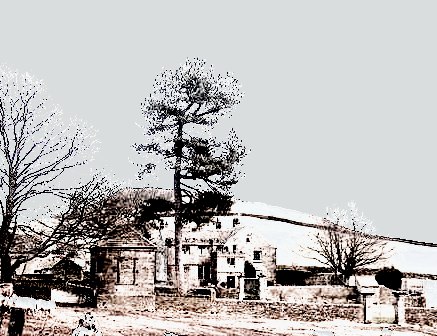
Huntley Castle, Aberdeenshire

There are at least a score of spectral White Ladies known  in England alone. I've heard of at least five in Wales (including the kindly Princess Nest of Carew Castle) and in Scotland, a good half dozen - usually in castles. Ireland (north and south of the border) has its share too. Thee are ghostly  ladies of other colours too, but white seems to be the most usual.

They are also found in Europe, and I believe other parts of the world. They usually seem to be sad, re-enacting some painful part of their lives. The white clothes could be their wedding dresses - or their shrouds.


White Lady remixed - original by Joseph Brauer


Because there are just so many to choose from, and because I'm from Yorkshire, I'm going to focus on three from the North:

A story from  Blenkinsopp Castle, Northumberland.
In the beginning of the 19th century ( Jane Austen's time) a poor family lived in part of the castle. One of the children,  a little boy of eight, was woken from his sleep by a richly dressed white lady. She begged him to go with her to recover a chest of treasure but he was too frightened. His tears woke his parents and the ghostly lady fled.
The boy emigrated to Canada as young man but still remembered her cold kisses in 1845. Towards the end of the 19th century, a vault was found. One brave man went down the long dark passageway and then down a twisting staircase. Something blew his candle out and he returned. Though he tried again, he never found the treasure.


Car park and ruins, Blenkinsopp Castle (Karl and Ali) / CC BY-SA 2.0

White-lass-beck, Thirsk, North Riding of Yorkshire
Here the stream was haunted by a young woman dressed in white who sometimes might change shape into a white dog. Some unfeeling workmen dug gravel out of the stream and found a skeleton of a girl supposed to have been murdered and the source of the haunting.

Highlow Hall, Derbyshire
This once grand 14th century manor house became a farmstead in Victorian times. A White Lady was seen drifting across the courtyard and then heard rustling her silk dress up the oak staircase. One farmworker touched his cap at her and tried to speak but she seemed not to see him. Another time, she was seen gazing down sadly at her reflection in a cattle trough at two in the morning.
The worst was the sound of thumps down the stairs - the sound of a murdered woman's body being dragged to an unknown grave.


Highlow Hall, Derbyshire (Neil Theasby) / CC BY-SA 2.0

Which is worse -  seeing a ghost or just hearing it?

Tuesday, 5 March 2013

Murdered Brides

My friend and colleague Diane McIlmoyle pointed me in the direction of a haunting by a murdered bride, knowing it was just my thing. Her account of the hauntings at Armboth House is on her excellent site on Cumbrian History and Folklore. Few things better than mysterious glowing lights on Halloween! (though I would say that scientists are still undecided about the cause of will o' the wisps)

She is now drowned in Thirlmere Reservoir
Here's one - a traditional story from American Folklore, with a headless bride for extra scariness. This one seems rather forlorn, still hoping for her groom to come.

The bride on Route 26 Maine never even makes it to her own wedding. She's a kind of spectral hitch hiker - though we don't know if she was murdered or an accident victim. Report from Strange Maine .

The disappointed bride of Waterworks Valley, St Lawrence, Jersey re-enacts her wedding procession. She takes out her loss on passers by, it seems.
You may hear the spectral coach rumbling up behind you.
Finally, how about this from the splendidly named Weddington Castle site? Not only is there the original story but a recent update - with photos. There's also a link to more information about the historical case which is worth a look.


Now only a ghostly memory itself...


Tuesday, 26 February 2013

A whiter shade of pale

Most English-speaking people will automatically think of a bride in white. Why?

It's a relatively recent idea - Victorian largely. It has to be said that most of the brides in Jane Austen's books time would have worn white too - but middle and upper class young ladies wore white most of time then.

Indeed, before the Victorians, many brides just wore their best dress,  perhaps given a make-over with the addition of tinsel, lace or ribbons.

It was Queen Victoria's own dress that started the trend - and that played on the idea of white for purity. In Ancient Rome, the Vestal Virgins (priestesses of the goddess Vesta) wore white. This symbolism was adopted by the new religion - Christianity. 

In medieval legend, the fierce white unicorn could only be tamed by a virgin. 

Many monks wore white to show they were pure in heart: the Carthusians, Premonstratensians, Mercedarians & Paulines. Children and unmarried women have often buried in white coffins to indicate their innocence. In St Oswald's Church, Flamborough, they have a pair of white paper gloves* last carried as was the custom at the funeral of a Miss Major in 1761. 


Interestingly, many cultures see white as the colour of mourning. Shinto brides in Japan wear a white kimono to show they have died to their own family. 

And to fit with my story, the shrouds that dead bodies used to be wrapped in, were of course, white.

*There are white paper maiden garlands - but these are so interesting, they deserve a separate post.

Thursday, 21 February 2013

The Bride of Frankenstein

We all know, of course that really it's the inventor who is Frankenstein in Mary Shelley's original tale.
'Frankenstein or The Modern Prometheus' was written when she was 19
But somehow the name has stuck to the creature - and to his bride-to-be. Interestingly in James Whale's 1935 film Elsa Lanchester plays both Mary Shelley here:

and the nameless Bride here:

Few images, and particularly hairstyles, can have had as much influence as hers created by Jack Pierce. Said to be inspired by the head of Nefertiti, it has gone to appear in all sorts of guises.


Photographer Flood has made herself into a Bride of Frankenstein:


Tommaso Jacobus has made this graphic:

I think it may have influenced the creation of Lily Munster:


And the following dolls have more than a touch of old Hollywood:


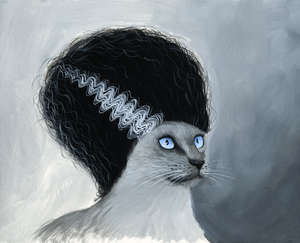
But a cat? Well, that's certainly recognisable.


In each case, it's interesting how this frankly unnerving bride has a kind of chilling elegance.


Tuesday, 12 February 2013

Left in the Lurch

The jilted bride - what a poignant idea that is! Filled with hope and joy for months, then having every expectation crushed at the last moment. No wonder we sympathise with the crazed Miss Havisham.
 Here's Cate Simmons' beautifully eerie take on Miss Havisham*
The writer Ronald Frame was so intrigued by Charles Dickens' jilted bride he wrote an entire backstory for her from the details in Great Expectations.
She may have been based on a real person: Eliza Emily Donnithorne (1826–1886) of Australia. Here's her grave:
Another famous literary disappointed bride is Jane Eyre. Mr Rochester is denounced as a bigamist at the altar. Still married to his mad wife Bertha, he cannot wed the distraught Jane.
In real life, the pain of such a loss can lead to suicide attempts.
Miss Li seen seven storeys up c/o NBC news 

Fortunately Miss Li was saved by Guo Zhongfan, a local community officer. She tried to kill herself after her fiancĂ© had left her and married another woman just days before their wedding.
Taking quite a different approach was Angela Burrow, previously a Major in the Queen Alexandra’s Royal Army Nursing Corps. She went ahead with the reception on New Year's Day at Tylney Hall, staging it as a 'new beginnings party', after her fiancĂ© of three and half years told her by text it was off.
Some might want revenge. Quentin Tarantino's The Bride in Kill Bill, for example, or this ghostly creation by Giulia:

How would you feel?


*For more delicate artwork, see  Cate Simmons Steering for North