Showing posts with label customs. Show all posts

Tuesday, 9 July 2013

Chimney sweep customs

Where I live in Sussex, some people have either wood or coal fires - and a chimney sweep offers his services in the Local Rag (it really is called that). He also offers 'wedding attendance'. If you're not from the British Isles - or not familiar with our more obscure customs, this might be a puzzle.

"The chimney sweep, by virtue of his blackened face and his connexion with fire and the hearth, is a very lucky person to meet by chance"
Encyclopaedia of Superstition 1948  E & M Radford, revised 1961 Christina Hole 

It was customary to bow or greet a chimney sweep 'in his blacks' - that is to say, when still grimy after his work. In some places, people would spit and make a wish. Apparently, chimney sweeps in Poland and Croatia wear all black and are thought lucky too. You touch a button to attract the magic.

Sweeps are used as New Year good luck charms in Germany
But the luck only worked if he was coming towards you.

This especially applied if a chimney sweep in his blacks should meet a bridal procession. Ideally he should turn and walk along beside the bride to bring her extra good fortune. If he had his back turned, that was a very ill omen.

So nowadays people sometimes hire sweeps to come to a wedding, bringing their good luck with them.

Black face morris men at Rochester Sweeps  Festival  c/o Jill Catley
I wonder if 'the virtue of the blackened face' is another reason for black-face morris men?  It is usually explained as a disguise - and most certainly is not racist unlike the Black and White Minstrels - but perhaps there is an element of black as a colour associated with fire and hearth magic.


After all, the hearth was where domestic rituals took place - and soot would be a product of such magical processes as making bread or smelting metal. Soot collected from your hearth could be used in spells against you, it was once believed. Soot could be made into a form of ink to create sigils and other magical writing -even tattoos.


So inviting a sweep to your wedding would seem like a good idea. If nothing else, it makes a good photo opportunity.

Tuesday, 25 June 2013

Wedding Bells

The sound of bells at a wedding may not always be a happy omen.

A traditional church wedding often includes a peal of bells. The noise of their sacred music is meant to drive any evil spirits away. In some places they used to ring bells to ward off lightning strikes. Most church bells have a Christian name - and in France, they are actually baptised. Holy water is used to name them, and the fumes from a censer removes any lurking malevolence.


The joyous sound of ringing the changes has meant bells appear on wedding cards, invitations and even as bell-shaped confetti. Few events at a wedding can be quite so shocking, though,  as this tale from the Daily Mail of a bell-ringer in 2008 dying at a wedding.

A muffled peal is where the sound of the clappers is softened with leather covers. It makes a dull and mournful sound. There are stories of this being done in mockery or spite at weddings years ago - say, if the groom hadn't paid the bell-ringers.


Single, tolling bells also have a bad reputation as they were rung to announce a death. Throughout history, bells have signalled bad news, such as invaders or war. They were even rung in times of plague, to tell people to bring out their dead and to pray for deliverance. So, over the years, the slow ringing of a bell has become a sign of bad luck. 


The unnerving sound of an unseen bell is often associated with water. From Celtic times, bells were thought to contain magic. Some say Druids threw bells into rivers, streams or springs to get rid of bad spirits and make the water pure. There are many stories of ghostly bells heard at sea and they are nearly always a warning of a storm or disaster. They are also often linked to the idea of a drowned town or city, like the once-busy port of Dunwich now lost beneath the sea.


What would you think if you heard the sound of a bell coming through the twilit mist?

Tuesday, 30 April 2013

Dia de los Muertos

The Day of the Dead, celebrated in Mexico and other usually Catholic countries.

The last time I was looking for images to go with my post about the Mistletoe Bride - I found one or two to do with  Dia de los Muertos. I put them on one side , resolving to use them later.


As it so happens, I have been invited  to a Mexican themed party. Immediately, I thought of Frida Kahlo - though not perhaps like this - dressed as a traditional Mexican bride with intricate lace and flowers on her crown and Diego Ribiera on her mind.


But it brought me back to those Day of the Dead Brides. In Mexico, the orange marigold or Flor de Muerto is thought to summon the dead. People make altars with sugar skulls and other offerings to their dead family members.


This bride seems to have been waiting a while.


And this one's even called the Waiting Bride.


 People make masks and there is a carnival atmosphere, I've read.


 You can dress up like this Corpse Bride by following the link below.
By Crafty Chica
But with all those masks and disguises, how can you know who - or what - is behind them?


Tuesday, 9 April 2013

Bridesmaids

The modern bride often has attendants of many different ages and dressed in different styles. Once she would not have done so. She would try to make all her maidens look the same as herself to confuse evil spirits. The bridesmaids would even have veils like her to set the demons a puzzle.

It could be trouble just being the bridesmaid  without demons. Some superstitions say that if a young woman is a bridesmaid three times, she won't get to be a bride herself - unless she can manage seven outings.
Similarly, a bridesmaid who stumbled on the way up the aisle was supposed to remain an 'old maid'.

And of course, straining to catch the bride's bouquet so you will wed next could lead to an accident.

There are some other oddities. Apparently in Kentucky:
If a bridesmaid goes to bed backward with her hand over her heart, she will be married before the year is out, provided the first man she sees in the morning is an old one.
Another is all the bridesmaids signing the bottom of the bride's shoe - the one whose name wears most will marry next.


In some places, bridesmaids might sleep with a piece of cake under their pillow and hope to dream of their own groom.

Some modern women might like this one:
If the bride wishes to be the dominant partner in the marriage, she must be the first to buy something after the wedding.  The quickest way to do this was to buy a pin from the chief bridesmaid when changing out of her bridal dress into her travelling outfit.
 Yet still I come back to the idea of evil spirits wanting to ruin the marriage - I find this quite haunting.

Tuesday, 2 April 2013

Something blue

According to the 19th century rhyme, for luck a bride should wear:
Something old, something new
Something borrowed and something blue
And a silver sixpence in her shoe.


An old piece of lace might be used for tradition - though you might want to think hard about who wore it last, perhaps.


The same might apply to something borrowed - can you be sure their marriage was truly happy? If luck can rub off on you, what about bad luck?


There's nothing too sinister about a new dress, but maybe the silver sixpence suggests warding off misfortune. Certainly the knot of similarly dressed bridesmaids and the bride's own veil were meant to confuse evil spirits.


What about blue then? The colour of the sky and the Virgin Mary's mantle - a symbol of purity and faithfulness. There is also a rhyme 'Marry in blue, lover be true' - blue sapphires are often used for engagement rings.


Blue can be cold- photographers use blue filters to give an unnatural feel - and we talk about feeling blue. I'm not sure if that's quite what you want on your wedding day.


Tuesday, 26 February 2013

A whiter shade of pale

Most English-speaking people will automatically think of a bride in white. Why?

It's a relatively recent idea - Victorian largely. It has to be said that most of the brides in Jane Austen's books time would have worn white too - but middle and upper class young ladies wore white most of time then.

Indeed, before the Victorians, many brides just wore their best dress,  perhaps given a make-over with the addition of tinsel, lace or ribbons.

It was Queen Victoria's own dress that started the trend - and that played on the idea of white for purity. In Ancient Rome, the Vestal Virgins (priestesses of the goddess Vesta) wore white. This symbolism was adopted by the new religion - Christianity. 

In medieval legend, the fierce white unicorn could only be tamed by a virgin. 

Many monks wore white to show they were pure in heart: the Carthusians, Premonstratensians, Mercedarians & Paulines. Children and unmarried women have often buried in white coffins to indicate their innocence. In St Oswald's Church, Flamborough, they have a pair of white paper gloves* last carried as was the custom at the funeral of a Miss Major in 1761. 


Interestingly, many cultures see white as the colour of mourning. Shinto brides in Japan wear a white kimono to show they have died to their own family. 

And to fit with my story, the shrouds that dead bodies used to be wrapped in, were of course, white.

*There are white paper maiden garlands - but these are so interesting, they deserve a separate post.

Wednesday, 15 August 2012

Old Ways about Weddings

As part of my research for The Wedding Ghost, I wanted to know about the traditions and superstitions around marriage in Sussex. At modern weddings we throw confetti, and in some places rice - but in Sussex it was wheat.
Ear of Wheat by Michael J. Connors
Morguefile

I've noticed Sussex churches often have lychgates - and so I 'borrowed' a custom  that's found in other counties. Local children, or members of the family, tie up the gates out of the churchyard, and won't let the Bride and Groom out until they pay a ransom.

Bolney Lychgate via John Gasson
Creative Commons
{The block in the middle is where they rested coffins}


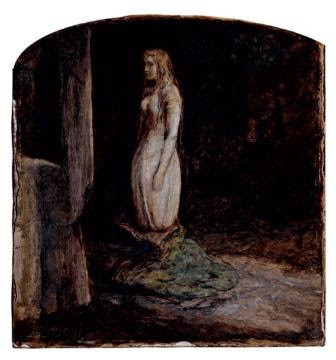
Traditionally, there were many ways for a young woman to find out who her husband would be. One of the best nights for such divination was the Eve of St. Agnes (20th January) John Keats wrote a marvellous, rather Gothic and sensual poem about this.
    They told her how, upon St. Agnes' Eve, 
     Young virgins might have visions of delight, 
     And soft adorings from their loves receive 
     Upon the honey'd middle of the night, 
     If ceremonies due they did aright; 
     As, supperless to bed they must retire, 
     And couch supine their beauties, lily white; 
     Nor look behind, nor sideways, but require 
  Of Heaven with upward eyes for all that they desire. 


'Madeline' by Millais 1850
courtesy of Martin Beek
Creative Commons

Halloween, of course, was another time. In Sussex, a young woman  would place an apple pip on the fire grate, representing the man she might marry. If the pip burned silently - that courtship would go smoothly with a happy ending; if the pip burst, they would break up.
Apple Pip by Mary K. Baird
Morguefile
I think you would have to be quite brave to try this last one. You waited until the first full moon was predicted after New Year's Day, then sit across a stile all alone in the dark. Of course, you had to keep still and silent - and probably go fasting according to most traditions - for the spell to work. When the moon rose you said this rhyme:
All hail to thee, Moon, all hail to thee,
I pray thee good Moon, reveal to me
This night who my husband must be.
Moonlight by Paul Anderson
Morguefile

Then you waited to see his 'glim' or spirit appear.
Would you dare?

Information from Superstitions of Love & Marriage by E. & M. A. Radford, ed. C. Hole, and  A Sussex Garland, T. Wales


Wednesday, 1 August 2012

Dead White Roses

August 1st is Yorkshire Day and as a Leeds-born lass, I had to mark it somehow. This blog being centred around a ghost story, I wanted to find something eerie.
Dead White Roses by Jeremy Cherfas
I love the elegantly macabre. I'm for the lovely but unnerving, so abandoned wreaths, the bouquets of forgotten brides and the remnants of faded beauty delight me. 
A skeleton form lay mouldering there
In the bridal weeds of a lady fair.
from the Mistletoe Bough by Thomas Haynes Bayley 1884
 
(Note: I've chosen a West Riding singer for this)

Now the War of the Roses included the bloodiest battle on English soil at Towton near Tadcaster. Not only was it gruesome, it also gave rise to several ghost stories (of Cock Beck running red with blood on the Palm Sunday anniversary, of groaning unseen warriors, and lights seen at night in Lead Chapel, which has no electricity) - and a legend about a rose.

The story goes that wild white roses grew around the site but ever after the battle, they came up splashed with blood from the dreadful battle. See here for more.

So ghosts, brides and roses have a welcome place here, and in my imagination, today and every day.