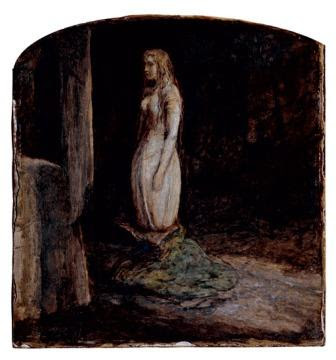
Showing posts with label The Wedding Ghost. Show all posts

Friday, 27 September 2013

The Return

Sunrise comes in a smear of blood red. Trees make black shadows against the low light. There's a hint of cold in the breeze as it moans over the window ledge. Autumn.


Outside bulging spiders hang on cobwebs. Some days drops of mist dangle on the thin strands instead. The first dead leaves gather under hedges.


Haws make clots of dark red on the field edges and the pheasants stalk amongst the stubble. Dusty asters bloom in neglected gardens. There has been mist rising from the rifes, the ditches that drain this low-lying land.


Mildew coats the marrow leaves with grey. Neither a bloom nor a leaf remains without a spot, a ragged edge or a stain of decaying colour.

The Wedding Ghost stirs in the cooling soil. The lengthening nights call to her.


Time to come back.

Tuesday, 26 March 2013

Considering the Lily

Brides have often carried lilies in their bouquets.


The bouquet itself may well come from the bunch of flowers and herbs that richer people carried in the Middle Ages. Different kinds were known as posies, tussie-mussies or nosegays. (The Queen still  carries one on Maundy Thursday). These were meant to keep away noxious smells and poisonous miasmas that caused disease.

The pure white Madonna lily is heavily scented. It is associated with the Virgin Mary as a symbol of innocence. 

Even so, many people won't have it indoors because it reminds them of funerals; before embalming, mortuary chapels and refrigeration, its powerful perfume was used to mask the smell of decay.


Similarly, the Calla or Arum lily can have a strong scent. In frost-free parts of America, it is grown on graves as a sign of resurrection. 

It was popular in the '20s and '30s in bridal sprays - very glamorous and Hollywood together with dropwaist satin dresses and headbands.

Finally, the name always makes me think of Lily Munster. I thought Yvonne de Carlo in the popular comedy of the 60s The Munsters was very beautiful in an eerie way.


Tuesday, 19 March 2013

Drawing a veil...

Brides in many cultures wear veils.


They represent modesty often - but there is also something mysterious about the half-covered face.

What is going on behind that gauze?


What is the bride truly feeling?

We might well wonder if anything is being concealed.

Perhaps lifting the veil might lead to something we would rather not see.

Tuesday, 5 February 2013

Window shopping

When I was little, I used to love staring into bridal shop windows.

I used to beg and plead  for my father to slow the car down outside the grandest ones in Leeds.

My younger self saw only glamour and beauty.

Now I see an impossible ideal: a fake purity.

The visions in white I used to see have taken on another aura.

One I find quite disturbing.

How about you?

Tuesday, 29 January 2013

The Bride of Dracula


I find the sinister yet beautiful image of a bride to Count Dracula rather alluring.
Something so innocent as a bride turned evil captures my imagination.
What could make her turn to such wickedness? Grief for someone corrupt?
A naturally cruel and stern disposition?
Straightforward bloodlust?
Malevolent company?
Or just an amazing photoshoot!


Who will be the black-hearted one in The Wedding Ghost?


Wednesday, 15 August 2012

Old Ways about Weddings

As part of my research for The Wedding Ghost, I wanted to know about the traditions and superstitions around marriage in Sussex. At modern weddings we throw confetti, and in some places rice - but in Sussex it was wheat.
Ear of Wheat by Michael J. Connors
Morguefile

I've noticed Sussex churches often have lychgates - and so I 'borrowed' a custom  that's found in other counties. Local children, or members of the family, tie up the gates out of the churchyard, and won't let the Bride and Groom out until they pay a ransom.

Bolney Lychgate via John Gasson
Creative Commons
{The block in the middle is where they rested coffins}


Traditionally, there were many ways for a young woman to find out who her husband would be. One of the best nights for such divination was the Eve of St. Agnes (20th January) John Keats wrote a marvellous, rather Gothic and sensual poem about this.
    They told her how, upon St. Agnes' Eve, 
     Young virgins might have visions of delight, 
     And soft adorings from their loves receive 
     Upon the honey'd middle of the night, 
     If ceremonies due they did aright; 
     As, supperless to bed they must retire, 
     And couch supine their beauties, lily white; 
     Nor look behind, nor sideways, but require 
  Of Heaven with upward eyes for all that they desire. 


'Madeline' by Millais 1850
courtesy of Martin Beek
Creative Commons

Halloween, of course, was another time. In Sussex, a young woman  would place an apple pip on the fire grate, representing the man she might marry. If the pip burned silently - that courtship would go smoothly with a happy ending; if the pip burst, they would break up.
Apple Pip by Mary K. Baird
Morguefile
I think you would have to be quite brave to try this last one. You waited until the first full moon was predicted after New Year's Day, then sit across a stile all alone in the dark. Of course, you had to keep still and silent - and probably go fasting according to most traditions - for the spell to work. When the moon rose you said this rhyme:
All hail to thee, Moon, all hail to thee,
I pray thee good Moon, reveal to me
This night who my husband must be.
Moonlight by Paul Anderson
Morguefile

Then you waited to see his 'glim' or spirit appear.
Would you dare?

Information from Superstitions of Love & Marriage by E. & M. A. Radford, ed. C. Hole, and  A Sussex Garland, T. Wales


Wednesday, 1 August 2012

Dead White Roses

August 1st is Yorkshire Day and as a Leeds-born lass, I had to mark it somehow. This blog being centred around a ghost story, I wanted to find something eerie.
Dead White Roses by Jeremy Cherfas
I love the elegantly macabre. I'm for the lovely but unnerving, so abandoned wreaths, the bouquets of forgotten brides and the remnants of faded beauty delight me. 
A skeleton form lay mouldering there
In the bridal weeds of a lady fair.
from the Mistletoe Bough by Thomas Haynes Bayley 1884
 
(Note: I've chosen a West Riding singer for this)

Now the War of the Roses included the bloodiest battle on English soil at Towton near Tadcaster. Not only was it gruesome, it also gave rise to several ghost stories (of Cock Beck running red with blood on the Palm Sunday anniversary, of groaning unseen warriors, and lights seen at night in Lead Chapel, which has no electricity) - and a legend about a rose.

The story goes that wild white roses grew around the site but ever after the battle, they came up splashed with blood from the dreadful battle. See here for more.

So ghosts, brides and roses have a welcome place here, and in my imagination, today and every day. 

Wednesday, 11 July 2012

Ghost Dresses

I find these enchanting - so delicate and ethereal in appearance - yet made from such a humble material. Sadly, I do not know the original sculptor - if you do, I'll happily credit them.
It occurs to me that hanging these from nylon fishing wire would make an even eerier effect - they were turn as though dancing to unheard music.

There's a link here to a sequence showing the construction of something similar - and spooky.

Monday, 28 May 2012

Where am I?


The first draft of The Wedding Ghost has been completed - and the opening chapter is with Greg Mosse. I feel rather in limbo waiting for for feedback so that I can move on.


It is like being surrounded with mist and listening for sounds. I'm a bit shivery and uncertain where to put my feet.  I hope the voice will lead me in the right direction but I am wary of trusting too much to someone else. Perhaps I may mistake which way to go, perhaps I am deluded. 


It's a scary business, this writing.

Monday, 9 April 2012

Starting off...

Inspirational reading
My current work in progress 'The Wedding Ghost' is taking shape. I am happy to admit that I owe a lot to Susan Hill's 'The Woman in Black' which I have loved since it came out in 1983. My story is quite distinct but informed by her structure - the way the mood shifts from beautiful description to eerie scenes and then on to deep fear - and yet there is a surprising amount of happiness too. The reader becomes aware of how much is threatened.
         I love ghost stories and I expect I will discuss a good few more as this blog develops. This first post is to acknowledge the debt that I owe one of my most-read writers. Few others convey that intensity of feeling with precision of observation in my view. It can feel a bit claustrophobic - but that is no bad thing in a supernatural tale, I believe. This strength of emotion is essential to a well-told ghost story - and my intention is to convey a similar psychological state. Prepare to be chilled.