Showing posts with label bride. Show all posts

Wednesday, 17 July 2013

Too hot to haunt

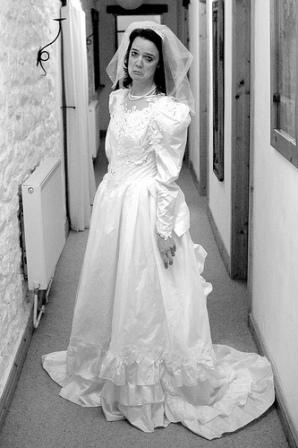
The Wedding Ghost cannot cope with the heat - and has departed.


There will be more eeriness when the weather is cooler - and spookier.

Goodbye for now...


please comment below or contact @lockwoodwriter if you have a topic you would like covered.

Tuesday, 9 July 2013

Chimney sweep customs

Where I live in Sussex, some people have either wood or coal fires - and a chimney sweep offers his services in the Local Rag (it really is called that). He also offers 'wedding attendance'. If you're not from the British Isles - or not familiar with our more obscure customs, this might be a puzzle.

"The chimney sweep, by virtue of his blackened face and his connexion with fire and the hearth, is a very lucky person to meet by chance"
Encyclopaedia of Superstition 1948  E & M Radford, revised 1961 Christina Hole 

It was customary to bow or greet a chimney sweep 'in his blacks' - that is to say, when still grimy after his work. In some places, people would spit and make a wish. Apparently, chimney sweeps in Poland and Croatia wear all black and are thought lucky too. You touch a button to attract the magic.

Sweeps are used as New Year good luck charms in Germany
But the luck only worked if he was coming towards you.

This especially applied if a chimney sweep in his blacks should meet a bridal procession. Ideally he should turn and walk along beside the bride to bring her extra good fortune. If he had his back turned, that was a very ill omen.

So nowadays people sometimes hire sweeps to come to a wedding, bringing their good luck with them.

Black face morris men at Rochester Sweeps  Festival  c/o Jill Catley
I wonder if 'the virtue of the blackened face' is another reason for black-face morris men?  It is usually explained as a disguise - and most certainly is not racist unlike the Black and White Minstrels - but perhaps there is an element of black as a colour associated with fire and hearth magic.


After all, the hearth was where domestic rituals took place - and soot would be a product of such magical processes as making bread or smelting metal. Soot collected from your hearth could be used in spells against you, it was once believed. Soot could be made into a form of ink to create sigils and other magical writing -even tattoos.


So inviting a sweep to your wedding would seem like a good idea. If nothing else, it makes a good photo opportunity.

Tuesday, 28 May 2013

Top Ten Tuesday

This has taken a while but here's a selection of Ghostly Brides. I shall start with the skull-faced Edwardian 'beauty'. Even the flowers she carries are dead.
Here the setting in Highgate Cemetery and her translucency all add to the eeriness. 
 Another see-through spectre. It's the way she challenges you to follow her - and yet the floor of the ruin shines right through her. Chilling.
A ghost bride doesn't have to be white European to be be sinister - this one is both beautiful and disturbing.
Of course, there are other ways to be scary. This zombie bride would rip anyone apart.
 Dead brides are unnerving. Would she 'wake' if you got too close?
And the sadness of this deserted bride -is it contagious, could she pass on her desperate plight?
Another waiting bride - this time from the twenties. The peeling wallpaper tells its own tale.
It's hard to beat a graveyard for the habitat of the supernatural .This bride is already in mourning - who for, I wonder?
But this has to be my Number One. There is something so implacable about her. She would never stop chasing you - slowly.

Tuesday, 21 May 2013

Brides and burials

On Sunday I was walking around a churchyard in Itchenor looking at gravestones. They can be very beautiful and sad - like this one here. This is from Chicago - so young and so lovely.


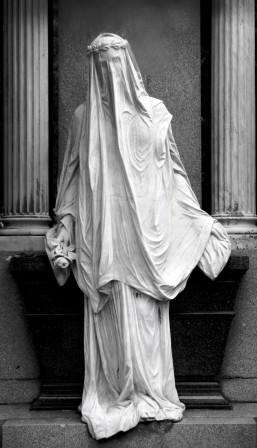
They can also be quite unnerving. This extraordinary funerary statue is from Brooklyn.
Rather older, this one seems to be in a shroud - or some sort of Greek veil.
It doesn't have to be white marble to be eerie. Bronze will do just as well.
I think it is the idea that they are waiting that people find unsettling. 


Tuesday, 14 May 2013

Wedding Woes


The convention is that your wedding day is 'the happiest day of your life'. I have found some bridal photographs that don't quite meet that ideal - sometimes deliberately.
Fashion shoot by Zhang Jigna

'Sad Bride' by Guilia
Others perhaps by accident. Did someone say something dreadful to her? 

Angry Bride by Cristina Valencia
Was this lady shocked by some terrible revelation ? 


 I don't think this one is taking it lying down.


I  can see revenge on the cards...


Tuesday, 7 May 2013

Reading the Banns

In the days when weddings could only take place in church, they used to announce the coming marriages for three weeks in a row. It was called Reading the Banns. It meant there was time for someone to raise an objection ( as happens in Jane Eyre).


There are a surprising number of superstitions about this. Some thought it was unlucky for the engaged couple to hear the banns -their future children would be cursed- so people would go to another church for those three weeks.

Up till the 1850s or so the Parish Clerk or the oldest man in the village would stand up after the last reading  and call out 'God speed them well'. The rest of the congregation had to say 'Amen' loudly to ward off bad luck .

In Perthshire they thought if the Banns were published in one Quarter but the marriage took place in another, it would be ill-fated. (The year was divided up by Quarter Days for things like paying rent)

 Quarter Days

  • Lady Day (25 March)
  • Midsummer Day (24 June)
  • Michaelmas (29 September)
  • Christmas (25 December)
It was very, very unlucky if a bell tolled for the death of someone on the same day as the Banns were read - especially if the corpse had been a married woman. They predicted the bride would not live longer than a year.

In the North of England ( where I come from)  folk would say the engaged couple had been 'asked', or in some places, 'shouted' when all three readings had taken place. In times past, there would be a great peal of bells to drive away any evil spirits. It was called the Spur-peal ( see Scots  spier or speer - to ask).

I suppose it comes down to the old idea of tempting fate - if you announce a celebration, some evil spirit might try to spoil it.
The Unlucky Bride


Tuesday, 30 April 2013

Dia de los Muertos

The Day of the Dead, celebrated in Mexico and other usually Catholic countries.

The last time I was looking for images to go with my post about the Mistletoe Bride - I found one or two to do with  Dia de los Muertos. I put them on one side , resolving to use them later.


As it so happens, I have been invited  to a Mexican themed party. Immediately, I thought of Frida Kahlo - though not perhaps like this - dressed as a traditional Mexican bride with intricate lace and flowers on her crown and Diego Ribiera on her mind.


But it brought me back to those Day of the Dead Brides. In Mexico, the orange marigold or Flor de Muerto is thought to summon the dead. People make altars with sugar skulls and other offerings to their dead family members.


This bride seems to have been waiting a while.


And this one's even called the Waiting Bride.


 People make masks and there is a carnival atmosphere, I've read.


 You can dress up like this Corpse Bride by following the link below.
By Crafty Chica
But with all those masks and disguises, how can you know who - or what - is behind them?


Tuesday, 23 April 2013

Winter Tales

A little early for Winter Tales perhaps - though recent chilly spring weather has made Winter seem an unwelcome, lingering guest.


I learned through The Bookseller that Orion are bringing out a book of Kate Mosse's supernatural short stories: The Mistletoe Bride & Other Winter Tales


Readers of this blog will know the The Mistletoe Bough is a favourite story of mine.


I will be interested to read how Kate deals with this traditional tale. It has been claimed by different places - but I had always thought of it as Northern. The poem on which the ballad is based though is quite different:

GINEVRA by Samuel Rogers 1822 (Public Domain)

If ever you should come to Modena,
(Where among other relics you may see 
Tassoni's bucket — but 'tis not the true one) 
Stop at a Palace near the Reggio-gate, 
Dwelt in of old by one of the Donati. 
Its noble gardens, terrace above terrace, 
And rich in fountains, statues, cypresses, 
Will long detain you — but, before you go, 
Enter the house — forget it not I pray you — 
And look awhile upon a picture there.

'Tis of a Lady in her earliest youth, 
The last of that illustrious family; 
Done by Zampieri — but by whom I care not. 
He, who observes it — ere he passes on, 
Gazes his fill, and comes and comes again, 
That he may call it up. when far away.

She sits, inclining forward as to speak, 
Her lips half open, and her finger up, 
As tho' she said "Beware!" her vest of gold 
Broidered with flowers and clasped from head to foot, 
An emerald-stone in every golden clasp; 
And on her brow, fairer than alabaster, 
A coronet of pearls.

But then her face, So lovely, yet so arch, so full of mirth, 
The overflowings of an innocent heart — 
It haunts me still, tho' many a year has fled, 
Like some wild melody!

Alone it hangs Over a mouldering heir-loom, its companion, 
An oaken-chest, half eaten by the worm, 
But richly carved by Antony of Trent 
With scripture-stories from the Life of Christ; 
A chest that came from Venice and had held 
The ducal robes of some old Ancestor — 
That by the way — it may be true or false — 
But don t forget the picture; and you will not, 
When you have heard the tale they told me there.


She was an only child — her name Ginevra, 
The joy, the pride of an indulgent Father; 
And in her fifteenth year became a bride, 
Marrying an only son, Francesco Doria, 
Her playmate from her birth, and her first love.

Just as she looks there in her bridal dress, 
She was all gentleness, all gaiety, 
Her pranks the favourite theme of every tongue. 
But now the day was come, the day, the hour; 
Now, frowning, smiling for the hundredth time, 
The nurse, that ancient lady, preached decorum; 
And, in the lustre of her youth, she gave 
Her hand, with her heart in it, to Francesco.

Great was the joy; but at the Nuptial feast, 
When all sate down, the Bride herself was wanting. 
Nor was she to be found! Her Father cried, 
"'Tis but to make a trial of our love!" 
And filled his glass to all; but his hand shook, 
And soon from guest to guest the panic spread. 
'Twas but that instant she had left Francesco, 
Laughing and looking back and flying still, 
Her ivory tooth imprinted on his finger. 
But now, alas, she was not to be found; 
Nor from that hour could any thing be guessed, 
But that she was not!

Weary of his life, 
Francesco flew to Venice, and, embarking, 
Flung it away in battle with the Turk. 
Donati lived — and long might you have seen 
An old man wandering as in quest of something, 
Something he could not find — he knew not what. 
When he was gone, the house remained awhile 
Silent and tenantless — then went to strangers.

Full fifty years were past, and all forgotten, 
When on an idle day, a day of search 
Mid the old lumber in the Gallery, 
That mouldering chest was noticed; and 'twas said 
By one as young, as thoughtless as Ginevra, 
"Why not remove it from its lurking-place?" 
'Twas done as soon as said; but on the way 
It burst, it fell; and lo, a skeleton, 
With here and there a pearl, an emerald-stone, 
A golden clasp, clasping a shred of gold, 
All else had perished — save a wedding-ring, 
And a small seal, her mother's legacy, 
Engraven with a name, the name of both, 
"Ginevra."

There then had she found a grave! 
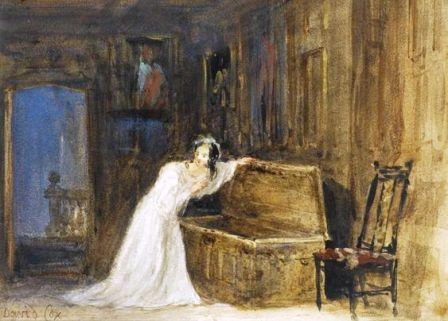
Within that chest had she concealed herself, 
Fluttering with joy, the happiest of the happy; 
When a spring-lock, that lay in ambush there, 
Fastened her down for ever!


Will Kate use the landscape of the Languedoc or the Weald to colour her work? I know The Wedding Ghost has more than a hint of the misty Sussex coast about it.


Tuesday, 16 April 2013

"What a comfort it is to possess the image of those who are removed from our sight..."

People like to remember those who have died. Before the invention of photography, only the wealthy could afford a portrait. 
The Dead Bride 1804

When daguerreotypes and other early forms of photograph became popular, the dead were not left out.

Corpse bride posed with dead flowers.

Note how the gloves cover up her hands - the fingers would be discoloured due to post-mortem decay.


This girl has been held up by a jig and some clever wiring. This is probably a confirmation dress rather than a wedding dress. Look at her blackened fingers.


These memento mori can be eerily beautiful. Some modern photographers imitate them to create art like Eveline Felice here:

and Mikimatto here:


Of course,  many times the bride wasn't dead at the time of the photograph, but there can still be something unsettling to us about these images.

Cards like this would handed out at funerals.

This porcelain image is on a grave in Chicago.
Certainly they remind us that we too will die.