Showing posts with label weddings. Show all posts

Tuesday, 9 July 2013

Chimney sweep customs

Where I live in Sussex, some people have either wood or coal fires - and a chimney sweep offers his services in the Local Rag (it really is called that). He also offers 'wedding attendance'. If you're not from the British Isles - or not familiar with our more obscure customs, this might be a puzzle.

"The chimney sweep, by virtue of his blackened face and his connexion with fire and the hearth, is a very lucky person to meet by chance"
Encyclopaedia of Superstition 1948  E & M Radford, revised 1961 Christina Hole 

It was customary to bow or greet a chimney sweep 'in his blacks' - that is to say, when still grimy after his work. In some places, people would spit and make a wish. Apparently, chimney sweeps in Poland and Croatia wear all black and are thought lucky too. You touch a button to attract the magic.

Sweeps are used as New Year good luck charms in Germany
But the luck only worked if he was coming towards you.

This especially applied if a chimney sweep in his blacks should meet a bridal procession. Ideally he should turn and walk along beside the bride to bring her extra good fortune. If he had his back turned, that was a very ill omen.

So nowadays people sometimes hire sweeps to come to a wedding, bringing their good luck with them.

Black face morris men at Rochester Sweeps  Festival  c/o Jill Catley
I wonder if 'the virtue of the blackened face' is another reason for black-face morris men?  It is usually explained as a disguise - and most certainly is not racist unlike the Black and White Minstrels - but perhaps there is an element of black as a colour associated with fire and hearth magic.


After all, the hearth was where domestic rituals took place - and soot would be a product of such magical processes as making bread or smelting metal. Soot collected from your hearth could be used in spells against you, it was once believed. Soot could be made into a form of ink to create sigils and other magical writing -even tattoos.


So inviting a sweep to your wedding would seem like a good idea. If nothing else, it makes a good photo opportunity.

Tuesday, 25 June 2013

Wedding Bells

The sound of bells at a wedding may not always be a happy omen.

A traditional church wedding often includes a peal of bells. The noise of their sacred music is meant to drive any evil spirits away. In some places they used to ring bells to ward off lightning strikes. Most church bells have a Christian name - and in France, they are actually baptised. Holy water is used to name them, and the fumes from a censer removes any lurking malevolence.


The joyous sound of ringing the changes has meant bells appear on wedding cards, invitations and even as bell-shaped confetti. Few events at a wedding can be quite so shocking, though,  as this tale from the Daily Mail of a bell-ringer in 2008 dying at a wedding.

A muffled peal is where the sound of the clappers is softened with leather covers. It makes a dull and mournful sound. There are stories of this being done in mockery or spite at weddings years ago - say, if the groom hadn't paid the bell-ringers.


Single, tolling bells also have a bad reputation as they were rung to announce a death. Throughout history, bells have signalled bad news, such as invaders or war. They were even rung in times of plague, to tell people to bring out their dead and to pray for deliverance. So, over the years, the slow ringing of a bell has become a sign of bad luck. 


The unnerving sound of an unseen bell is often associated with water. From Celtic times, bells were thought to contain magic. Some say Druids threw bells into rivers, streams or springs to get rid of bad spirits and make the water pure. There are many stories of ghostly bells heard at sea and they are nearly always a warning of a storm or disaster. They are also often linked to the idea of a drowned town or city, like the once-busy port of Dunwich now lost beneath the sea.


What would you think if you heard the sound of a bell coming through the twilit mist?

Tuesday, 28 May 2013

Top Ten Tuesday

This has taken a while but here's a selection of Ghostly Brides. I shall start with the skull-faced Edwardian 'beauty'. Even the flowers she carries are dead.
Here the setting in Highgate Cemetery and her translucency all add to the eeriness. 
 Another see-through spectre. It's the way she challenges you to follow her - and yet the floor of the ruin shines right through her. Chilling.
A ghost bride doesn't have to be white European to be be sinister - this one is both beautiful and disturbing.
Of course, there are other ways to be scary. This zombie bride would rip anyone apart.
 Dead brides are unnerving. Would she 'wake' if you got too close?
And the sadness of this deserted bride -is it contagious, could she pass on her desperate plight?
Another waiting bride - this time from the twenties. The peeling wallpaper tells its own tale.
It's hard to beat a graveyard for the habitat of the supernatural .This bride is already in mourning - who for, I wonder?
But this has to be my Number One. There is something so implacable about her. She would never stop chasing you - slowly.

Tuesday, 21 May 2013

Brides and burials

On Sunday I was walking around a churchyard in Itchenor looking at gravestones. They can be very beautiful and sad - like this one here. This is from Chicago - so young and so lovely.


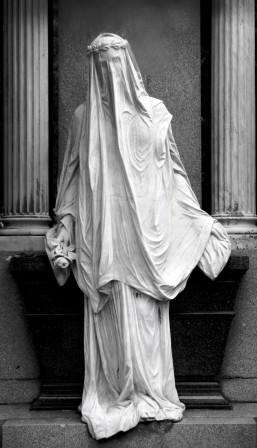
They can also be quite unnerving. This extraordinary funerary statue is from Brooklyn.
Rather older, this one seems to be in a shroud - or some sort of Greek veil.
It doesn't have to be white marble to be eerie. Bronze will do just as well.
I think it is the idea that they are waiting that people find unsettling. 


Tuesday, 9 April 2013

Bridesmaids

The modern bride often has attendants of many different ages and dressed in different styles. Once she would not have done so. She would try to make all her maidens look the same as herself to confuse evil spirits. The bridesmaids would even have veils like her to set the demons a puzzle.

It could be trouble just being the bridesmaid  without demons. Some superstitions say that if a young woman is a bridesmaid three times, she won't get to be a bride herself - unless she can manage seven outings.
Similarly, a bridesmaid who stumbled on the way up the aisle was supposed to remain an 'old maid'.

And of course, straining to catch the bride's bouquet so you will wed next could lead to an accident.

There are some other oddities. Apparently in Kentucky:
If a bridesmaid goes to bed backward with her hand over her heart, she will be married before the year is out, provided the first man she sees in the morning is an old one.
Another is all the bridesmaids signing the bottom of the bride's shoe - the one whose name wears most will marry next.


In some places, bridesmaids might sleep with a piece of cake under their pillow and hope to dream of their own groom.

Some modern women might like this one:
If the bride wishes to be the dominant partner in the marriage, she must be the first to buy something after the wedding.  The quickest way to do this was to buy a pin from the chief bridesmaid when changing out of her bridal dress into her travelling outfit.
 Yet still I come back to the idea of evil spirits wanting to ruin the marriage - I find this quite haunting.

Tuesday, 26 March 2013

Considering the Lily

Brides have often carried lilies in their bouquets.


The bouquet itself may well come from the bunch of flowers and herbs that richer people carried in the Middle Ages. Different kinds were known as posies, tussie-mussies or nosegays. (The Queen still  carries one on Maundy Thursday). These were meant to keep away noxious smells and poisonous miasmas that caused disease.

The pure white Madonna lily is heavily scented. It is associated with the Virgin Mary as a symbol of innocence. 

Even so, many people won't have it indoors because it reminds them of funerals; before embalming, mortuary chapels and refrigeration, its powerful perfume was used to mask the smell of decay.


Similarly, the Calla or Arum lily can have a strong scent. In frost-free parts of America, it is grown on graves as a sign of resurrection. 

It was popular in the '20s and '30s in bridal sprays - very glamorous and Hollywood together with dropwaist satin dresses and headbands.

Finally, the name always makes me think of Lily Munster. I thought Yvonne de Carlo in the popular comedy of the 60s The Munsters was very beautiful in an eerie way.


Tuesday, 26 February 2013

A whiter shade of pale

Most English-speaking people will automatically think of a bride in white. Why?

It's a relatively recent idea - Victorian largely. It has to be said that most of the brides in Jane Austen's books time would have worn white too - but middle and upper class young ladies wore white most of time then.

Indeed, before the Victorians, many brides just wore their best dress,  perhaps given a make-over with the addition of tinsel, lace or ribbons.

It was Queen Victoria's own dress that started the trend - and that played on the idea of white for purity. In Ancient Rome, the Vestal Virgins (priestesses of the goddess Vesta) wore white. This symbolism was adopted by the new religion - Christianity. 

In medieval legend, the fierce white unicorn could only be tamed by a virgin. 

Many monks wore white to show they were pure in heart: the Carthusians, Premonstratensians, Mercedarians & Paulines. Children and unmarried women have often buried in white coffins to indicate their innocence. In St Oswald's Church, Flamborough, they have a pair of white paper gloves* last carried as was the custom at the funeral of a Miss Major in 1761. 


Interestingly, many cultures see white as the colour of mourning. Shinto brides in Japan wear a white kimono to show they have died to their own family. 

And to fit with my story, the shrouds that dead bodies used to be wrapped in, were of course, white.

*There are white paper maiden garlands - but these are so interesting, they deserve a separate post.

Thursday, 21 February 2013

The Bride of Frankenstein

We all know, of course that really it's the inventor who is Frankenstein in Mary Shelley's original tale.
'Frankenstein or The Modern Prometheus' was written when she was 19
But somehow the name has stuck to the creature - and to his bride-to-be. Interestingly in James Whale's 1935 film Elsa Lanchester plays both Mary Shelley here:

and the nameless Bride here:

Few images, and particularly hairstyles, can have had as much influence as hers created by Jack Pierce. Said to be inspired by the head of Nefertiti, it has gone to appear in all sorts of guises.


Photographer Flood has made herself into a Bride of Frankenstein:


Tommaso Jacobus has made this graphic:

I think it may have influenced the creation of Lily Munster:


And the following dolls have more than a touch of old Hollywood:


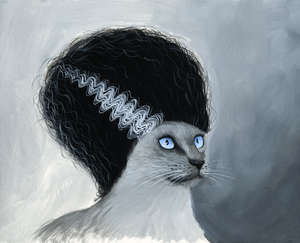
But a cat? Well, that's certainly recognisable.


In each case, it's interesting how this frankly unnerving bride has a kind of chilling elegance.