Showing posts with label gowns. Show all posts

Tuesday, 9 April 2013

Bridesmaids

The modern bride often has attendants of many different ages and dressed in different styles. Once she would not have done so. She would try to make all her maidens look the same as herself to confuse evil spirits. The bridesmaids would even have veils like her to set the demons a puzzle.

It could be trouble just being the bridesmaid  without demons. Some superstitions say that if a young woman is a bridesmaid three times, she won't get to be a bride herself - unless she can manage seven outings.
Similarly, a bridesmaid who stumbled on the way up the aisle was supposed to remain an 'old maid'.

And of course, straining to catch the bride's bouquet so you will wed next could lead to an accident.

There are some other oddities. Apparently in Kentucky:
If a bridesmaid goes to bed backward with her hand over her heart, she will be married before the year is out, provided the first man she sees in the morning is an old one.
Another is all the bridesmaids signing the bottom of the bride's shoe - the one whose name wears most will marry next.


In some places, bridesmaids might sleep with a piece of cake under their pillow and hope to dream of their own groom.

Some modern women might like this one:
If the bride wishes to be the dominant partner in the marriage, she must be the first to buy something after the wedding.  The quickest way to do this was to buy a pin from the chief bridesmaid when changing out of her bridal dress into her travelling outfit.
 Yet still I come back to the idea of evil spirits wanting to ruin the marriage - I find this quite haunting.

Tuesday, 2 April 2013

Something blue

According to the 19th century rhyme, for luck a bride should wear:
Something old, something new
Something borrowed and something blue
And a silver sixpence in her shoe.


An old piece of lace might be used for tradition - though you might want to think hard about who wore it last, perhaps.


The same might apply to something borrowed - can you be sure their marriage was truly happy? If luck can rub off on you, what about bad luck?


There's nothing too sinister about a new dress, but maybe the silver sixpence suggests warding off misfortune. Certainly the knot of similarly dressed bridesmaids and the bride's own veil were meant to confuse evil spirits.


What about blue then? The colour of the sky and the Virgin Mary's mantle - a symbol of purity and faithfulness. There is also a rhyme 'Marry in blue, lover be true' - blue sapphires are often used for engagement rings.


Blue can be cold- photographers use blue filters to give an unnatural feel - and we talk about feeling blue. I'm not sure if that's quite what you want on your wedding day.


Tuesday, 12 March 2013

The Women in White...

... or the many White Ladies that haunt the British Isles.

Huntley Castle, Aberdeenshire

There are at least a score of spectral White Ladies known  in England alone. I've heard of at least five in Wales (including the kindly Princess Nest of Carew Castle) and in Scotland, a good half dozen - usually in castles. Ireland (north and south of the border) has its share too. Thee are ghostly  ladies of other colours too, but white seems to be the most usual.

They are also found in Europe, and I believe other parts of the world. They usually seem to be sad, re-enacting some painful part of their lives. The white clothes could be their wedding dresses - or their shrouds.


White Lady remixed - original by Joseph Brauer


Because there are just so many to choose from, and because I'm from Yorkshire, I'm going to focus on three from the North:

A story from  Blenkinsopp Castle, Northumberland.
In the beginning of the 19th century ( Jane Austen's time) a poor family lived in part of the castle. One of the children,  a little boy of eight, was woken from his sleep by a richly dressed white lady. She begged him to go with her to recover a chest of treasure but he was too frightened. His tears woke his parents and the ghostly lady fled.
The boy emigrated to Canada as young man but still remembered her cold kisses in 1845. Towards the end of the 19th century, a vault was found. One brave man went down the long dark passageway and then down a twisting staircase. Something blew his candle out and he returned. Though he tried again, he never found the treasure.


Car park and ruins, Blenkinsopp Castle (Karl and Ali) / CC BY-SA 2.0

White-lass-beck, Thirsk, North Riding of Yorkshire
Here the stream was haunted by a young woman dressed in white who sometimes might change shape into a white dog. Some unfeeling workmen dug gravel out of the stream and found a skeleton of a girl supposed to have been murdered and the source of the haunting.

Highlow Hall, Derbyshire
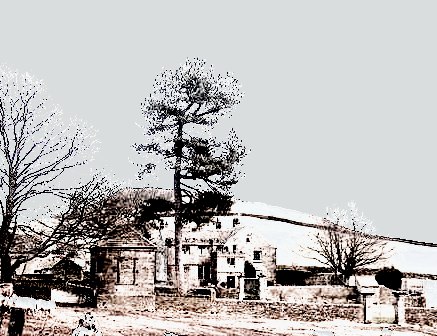
This once grand 14th century manor house became a farmstead in Victorian times. A White Lady was seen drifting across the courtyard and then heard rustling her silk dress up the oak staircase. One farmworker touched his cap at her and tried to speak but she seemed not to see him. Another time, she was seen gazing down sadly at her reflection in a cattle trough at two in the morning.
The worst was the sound of thumps down the stairs - the sound of a murdered woman's body being dragged to an unknown grave.


Highlow Hall, Derbyshire (Neil Theasby) / CC BY-SA 2.0

Which is worse -  seeing a ghost or just hearing it?

Tuesday, 26 February 2013

A whiter shade of pale

Most English-speaking people will automatically think of a bride in white. Why?

It's a relatively recent idea - Victorian largely. It has to be said that most of the brides in Jane Austen's books time would have worn white too - but middle and upper class young ladies wore white most of time then.

Indeed, before the Victorians, many brides just wore their best dress,  perhaps given a make-over with the addition of tinsel, lace or ribbons.

It was Queen Victoria's own dress that started the trend - and that played on the idea of white for purity. In Ancient Rome, the Vestal Virgins (priestesses of the goddess Vesta) wore white. This symbolism was adopted by the new religion - Christianity. 

In medieval legend, the fierce white unicorn could only be tamed by a virgin. 

Many monks wore white to show they were pure in heart: the Carthusians, Premonstratensians, Mercedarians & Paulines. Children and unmarried women have often buried in white coffins to indicate their innocence. In St Oswald's Church, Flamborough, they have a pair of white paper gloves* last carried as was the custom at the funeral of a Miss Major in 1761. 


Interestingly, many cultures see white as the colour of mourning. Shinto brides in Japan wear a white kimono to show they have died to their own family. 

And to fit with my story, the shrouds that dead bodies used to be wrapped in, were of course, white.

*There are white paper maiden garlands - but these are so interesting, they deserve a separate post.

Tuesday, 29 January 2013

The Bride of Dracula


I find the sinister yet beautiful image of a bride to Count Dracula rather alluring.
Something so innocent as a bride turned evil captures my imagination.
What could make her turn to such wickedness? Grief for someone corrupt?
A naturally cruel and stern disposition?
Straightforward bloodlust?
Malevolent company?
Or just an amazing photoshoot!


Who will be the black-hearted one in The Wedding Ghost?


Tuesday, 22 January 2013

Miss Havisham

This blog is all about spooky brides - so I couldn't miss out the wonderfully theatrical Miss Havisham. She's the bitter and twisted spinster in Charles Dickens' 'Great Expectations'.

Here she looks a very Grande Dame.

She was jilted by the swindler Compeyson at twenty to nine on the morning of her wedding. Ever afterwards she wore her wedding dress and just one shoe. 


All the clocks in her house were stopped at twenty to nine.


The Wedding Breakfast - including the cake - was left to moulder away.


She teaches her adopted daughter, Estella, to despise men. Estella then breaks the heart of Pip -which Miss Havisham regrets later. She begs forgiveness shortly before her dress catches fire and she dies of her injuries.


Was she an old lady?
Or rather younger?

Certainly an inspiration for photographers:


How do you imagine her?


Wednesday, 11 July 2012

Ghost Dresses

I find these enchanting - so delicate and ethereal in appearance - yet made from such a humble material. Sadly, I do not know the original sculptor - if you do, I'll happily credit them.
It occurs to me that hanging these from nylon fishing wire would make an even eerier effect - they were turn as though dancing to unheard music.

There's a link here to a sequence showing the construction of something similar - and spooky.