Tuesday, 16 April 2013

"What a comfort it is to possess the image of those who are removed from our sight..."

People like to remember those who have died. Before the invention of photography, only the wealthy could afford a portrait. 
The Dead Bride 1804

When daguerreotypes and other early forms of photograph became popular, the dead were not left out.

Corpse bride posed with dead flowers.

Note how the gloves cover up her hands - the fingers would be discoloured due to post-mortem decay.


This girl has been held up by a jig and some clever wiring. This is probably a confirmation dress rather than a wedding dress. Look at her blackened fingers.


These memento mori can be eerily beautiful. Some modern photographers imitate them to create art like Eveline Felice here:

and Mikimatto here:


Of course,  many times the bride wasn't dead at the time of the photograph, but there can still be something unsettling to us about these images.

Cards like this would handed out at funerals.

This porcelain image is on a grave in Chicago.
Certainly they remind us that we too will die.


Tuesday, 9 April 2013

Bridesmaids

The modern bride often has attendants of many different ages and dressed in different styles. Once she would not have done so. She would try to make all her maidens look the same as herself to confuse evil spirits. The bridesmaids would even have veils like her to set the demons a puzzle.

It could be trouble just being the bridesmaid  without demons. Some superstitions say that if a young woman is a bridesmaid three times, she won't get to be a bride herself - unless she can manage seven outings.
Similarly, a bridesmaid who stumbled on the way up the aisle was supposed to remain an 'old maid'.

And of course, straining to catch the bride's bouquet so you will wed next could lead to an accident.

There are some other oddities. Apparently in Kentucky:
If a bridesmaid goes to bed backward with her hand over her heart, she will be married before the year is out, provided the first man she sees in the morning is an old one.
Another is all the bridesmaids signing the bottom of the bride's shoe - the one whose name wears most will marry next.


In some places, bridesmaids might sleep with a piece of cake under their pillow and hope to dream of their own groom.

Some modern women might like this one:
If the bride wishes to be the dominant partner in the marriage, she must be the first to buy something after the wedding.  The quickest way to do this was to buy a pin from the chief bridesmaid when changing out of her bridal dress into her travelling outfit.
 Yet still I come back to the idea of evil spirits wanting to ruin the marriage - I find this quite haunting.

Tuesday, 2 April 2013

Something blue

According to the 19th century rhyme, for luck a bride should wear:
Something old, something new
Something borrowed and something blue
And a silver sixpence in her shoe.


An old piece of lace might be used for tradition - though you might want to think hard about who wore it last, perhaps.


The same might apply to something borrowed - can you be sure their marriage was truly happy? If luck can rub off on you, what about bad luck?


There's nothing too sinister about a new dress, but maybe the silver sixpence suggests warding off misfortune. Certainly the knot of similarly dressed bridesmaids and the bride's own veil were meant to confuse evil spirits.


What about blue then? The colour of the sky and the Virgin Mary's mantle - a symbol of purity and faithfulness. There is also a rhyme 'Marry in blue, lover be true' - blue sapphires are often used for engagement rings.


Blue can be cold- photographers use blue filters to give an unnatural feel - and we talk about feeling blue. I'm not sure if that's quite what you want on your wedding day.


Tuesday, 26 March 2013

Considering the Lily

Brides have often carried lilies in their bouquets.


The bouquet itself may well come from the bunch of flowers and herbs that richer people carried in the Middle Ages. Different kinds were known as posies, tussie-mussies or nosegays. (The Queen still  carries one on Maundy Thursday). These were meant to keep away noxious smells and poisonous miasmas that caused disease.

The pure white Madonna lily is heavily scented. It is associated with the Virgin Mary as a symbol of innocence. 

Even so, many people won't have it indoors because it reminds them of funerals; before embalming, mortuary chapels and refrigeration, its powerful perfume was used to mask the smell of decay.


Similarly, the Calla or Arum lily can have a strong scent. In frost-free parts of America, it is grown on graves as a sign of resurrection. 

It was popular in the '20s and '30s in bridal sprays - very glamorous and Hollywood together with dropwaist satin dresses and headbands.

Finally, the name always makes me think of Lily Munster. I thought Yvonne de Carlo in the popular comedy of the 60s The Munsters was very beautiful in an eerie way.


Tuesday, 19 March 2013

Drawing a veil...

Brides in many cultures wear veils.


They represent modesty often - but there is also something mysterious about the half-covered face.

What is going on behind that gauze?


What is the bride truly feeling?

We might well wonder if anything is being concealed.

Perhaps lifting the veil might lead to something we would rather not see.

Tuesday, 12 March 2013

The Women in White...

... or the many White Ladies that haunt the British Isles.

Huntley Castle, Aberdeenshire

There are at least a score of spectral White Ladies known  in England alone. I've heard of at least five in Wales (including the kindly Princess Nest of Carew Castle) and in Scotland, a good half dozen - usually in castles. Ireland (north and south of the border) has its share too. Thee are ghostly  ladies of other colours too, but white seems to be the most usual.

They are also found in Europe, and I believe other parts of the world. They usually seem to be sad, re-enacting some painful part of their lives. The white clothes could be their wedding dresses - or their shrouds.


White Lady remixed - original by Joseph Brauer


Because there are just so many to choose from, and because I'm from Yorkshire, I'm going to focus on three from the North:

A story from  Blenkinsopp Castle, Northumberland.
In the beginning of the 19th century ( Jane Austen's time) a poor family lived in part of the castle. One of the children,  a little boy of eight, was woken from his sleep by a richly dressed white lady. She begged him to go with her to recover a chest of treasure but he was too frightened. His tears woke his parents and the ghostly lady fled.
The boy emigrated to Canada as young man but still remembered her cold kisses in 1845. Towards the end of the 19th century, a vault was found. One brave man went down the long dark passageway and then down a twisting staircase. Something blew his candle out and he returned. Though he tried again, he never found the treasure.


Car park and ruins, Blenkinsopp Castle (Karl and Ali) / CC BY-SA 2.0

White-lass-beck, Thirsk, North Riding of Yorkshire
Here the stream was haunted by a young woman dressed in white who sometimes might change shape into a white dog. Some unfeeling workmen dug gravel out of the stream and found a skeleton of a girl supposed to have been murdered and the source of the haunting.

Highlow Hall, Derbyshire
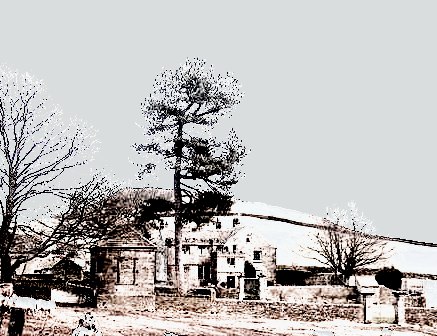
This once grand 14th century manor house became a farmstead in Victorian times. A White Lady was seen drifting across the courtyard and then heard rustling her silk dress up the oak staircase. One farmworker touched his cap at her and tried to speak but she seemed not to see him. Another time, she was seen gazing down sadly at her reflection in a cattle trough at two in the morning.
The worst was the sound of thumps down the stairs - the sound of a murdered woman's body being dragged to an unknown grave.


Highlow Hall, Derbyshire (Neil Theasby) / CC BY-SA 2.0

Which is worse -  seeing a ghost or just hearing it?

Tuesday, 5 March 2013

Murdered Brides

My friend and colleague Diane McIlmoyle pointed me in the direction of a haunting by a murdered bride, knowing it was just my thing. Her account of the hauntings at Armboth House is on her excellent site on Cumbrian History and Folklore. Few things better than mysterious glowing lights on Halloween! (though I would say that scientists are still undecided about the cause of will o' the wisps)

She is now drowned in Thirlmere Reservoir
Here's one - a traditional story from American Folklore, with a headless bride for extra scariness. This one seems rather forlorn, still hoping for her groom to come.

The bride on Route 26 Maine never even makes it to her own wedding. She's a kind of spectral hitch hiker - though we don't know if she was murdered or an accident victim. Report from Strange Maine .

The disappointed bride of Waterworks Valley, St Lawrence, Jersey re-enacts her wedding procession. She takes out her loss on passers by, it seems.
You may hear the spectral coach rumbling up behind you.
Finally, how about this from the splendidly named Weddington Castle site? Not only is there the original story but a recent update - with photos. There's also a link to more information about the historical case which is worth a look.


Now only a ghostly memory itself...