A review of Kate Mosse's supernatural short story collection.
My more frequent readers and friends probably know I have a soft spot for any variation of the Mistletoe Bride legend ( see a previous post here.) So when a book came out with two re-tellings, I had to have it - or to be precise, to hear it. I listened to THE MISTLETOE BRIDE AND OTHER HAUNTING TALES on a long dark and bleak journey to Yorkshire and back. Ideal.
This collection is on the gentler, more lyrical side of creepy - more eerie than horrific . There is one psychological tale I found more disturbing - but I can't say much without spoilers. There's a wide range of historical settings - and as you might expect from Kate Mosse, a strong sense of place.
These are strongly visual stories. There are black and white illustrations by Rohan Eason in the hardback edition (which sadly I don't have yet) some of which I have included here. I could easily imagine many as rather arty animations accompanied with weird little waltzes and whatnot in a minor key.
If you enjoy Susan Hill's supernatural tales, and own a few by M. R. James and Edith Wharton, this will sit well on your shelves. The stories mostly deliver pleasurable chills rather than shudders of distaste and horror. They are definitely not for fans of the gorefest.
The Wedding Ghost approves.
Supernatural postings from K. M. Lockwood - all things eerie that feed my writing.
Tuesday, 12 November 2013
THE MISTLETOE BRIDE AND OTHER HAUNTING TALES
Thursday, 31 October 2013
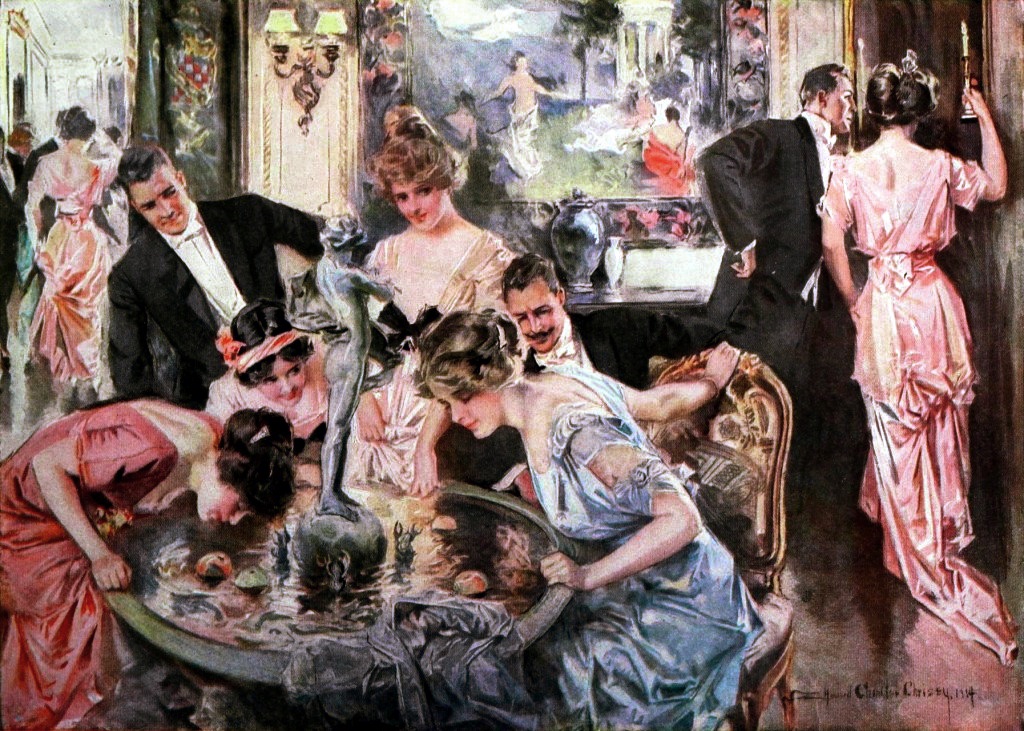
Hallowtide Apples
I had to mark Hallowe'en itself with something following on from Olivia Keirnan's fascinating post last week. I loved how these are living traditions in Ireland.
Mine is more historical - but it still features apples. Perhaps it's something to do with Eve, but they do reoccur in ways of divining your future in love in many parts of the British Isles.
Lots of Hallowe'en traditions were social. One involved all the unmarried young people tying their apple onto a string and twirling it close to the fire. The quicker the apple came off the string, the sooner you would be married. Pity the poor girl whose apple stayed on till last.
A girl with several suitors might name an apple pip for each one and then put them on her cheek. They would fall off as they dried and the last one left would be for the faithful lover. You could do a similar rite with the pips on the fire grate saying this spell:
A solitary way of finding your true love's name was for the brave, I think. You stood alone in your room at midnight and peeled an apple by the light of one candle. You had to stand in front of a mirror without looking round. You made the longest peel that you could so the marriage would last - and then threw the peel over your shoulder. Some traditions say it would spell out your true love's initials - others that their spirit would appear.
In Cornwall it was known as Allantide - and children were given Allan apples for luck. A girl might put one under her pillow to see if she would dream of her future husband.
A young man would need a lot of apples pips for this last one - or ashes from the Halloween Bonfire. He would find a path often used by girls he liked and lay a trail. The first girl to follow it would be his sweetheart.
Mine is more historical - but it still features apples. Perhaps it's something to do with Eve, but they do reoccur in ways of divining your future in love in many parts of the British Isles.
Lots of Hallowe'en traditions were social. One involved all the unmarried young people tying their apple onto a string and twirling it close to the fire. The quicker the apple came off the string, the sooner you would be married. Pity the poor girl whose apple stayed on till last.
A girl with several suitors might name an apple pip for each one and then put them on her cheek. They would fall off as they dried and the last one left would be for the faithful lover. You could do a similar rite with the pips on the fire grate saying this spell:
If you love me, bounce and fly,
If you hate me, lie and die .In Sussex where I live now, it was the other way round: a burst pip meant marrying that person would be a disaster.
A solitary way of finding your true love's name was for the brave, I think. You stood alone in your room at midnight and peeled an apple by the light of one candle. You had to stand in front of a mirror without looking round. You made the longest peel that you could so the marriage would last - and then threw the peel over your shoulder. Some traditions say it would spell out your true love's initials - others that their spirit would appear.
In Cornwall it was known as Allantide - and children were given Allan apples for luck. A girl might put one under her pillow to see if she would dream of her future husband.
A young man would need a lot of apples pips for this last one - or ashes from the Halloween Bonfire. He would find a path often used by girls he liked and lay a trail. The first girl to follow it would be his sweetheart.
Labels:
Autumn,
hallowe'en,
marriage,
superstitions
Wednesday, 23 October 2013
Irish Halloween traditions: Wedding Rings, Apples and Barm Brack
A special guest post from the talented Irish writer, Olivia Kiernan
Halloween is upon us and the veil that keeps the
non-living from the living has been lifted. Halloween is a Celtic and pagan
tradition. Known in Ireland as OĆche Shamhna,
it is a chance for the flesh and blood among us to ask those who have passed,
to foretell our fortunes. So how does one ask the otherworld whom they might
marry or what life might hold for us. These are a few games to while away the
dark and spooky hours on All Hallow’s Eve.
Bobbing apples was one of my favourite games as a
child, possibly not the most hygienic but great fun. The aim was to try and
grab an apple from a tub of water, hands behind the back and using only the
mouth. Once the wayward apple was caught, it was then used as an object to
predict your future wife or husband. The skin was peeled and thrown over the
left shoulder; the shape it formed on the ground was seen to represent the
first initial of your true love.
As with most children at Halloween, I was particularly
drawn to the macabre. The following method of fortune telling both thrilled and
terrified me, but I was never too scared not to want to take part. Five saucers
were laid on the kitchen table. Each one containing a single ingredient: water
(meaning a journey overseas), clay (meaning death, hence my terror!), ring
(meaning marriage), rag (meaning poverty) and finally coins (meaning riches).
The participant would be blindfolded, spun three times and then was directed to
reach out to one of the saucers and so discovering what fate awaited them in
their future.
![]() |
| Image from Erin Darcy photography |
And of course, no
Irish Halloween would be complete with the Barm Brack. This was a light, yeast bread
studded with sultanas and raisins. It’s something of a ritual in most Irish
households at Halloween. At the end of the evening the brack, is sliced, to be
shared out among the guests where one lucky person will find a ring buried in
the dough. Of course, this indicated that person would
soon be married.
A big thank you to KM Lockwood for giving me the
opportunity to post on The Wedding Ghost. Wishing you all a great Halloween!
Olivia Kiernan is
author of Dawn Solstice.
Blog:
www.oliviakiernan.wordpress.com
Twitter: @LivKiernan
On facebook: Olivia
Kiernan (Author)
Tuesday, 15 October 2013
Tangled webs
Webs are fascinating in an eerie way. The delicacy of construction - and the strength of the silk.
The meticulous order of some - elegant, regular and meant for death.
The exuberant chaos of others - messy and changeable whichever way you look at them.
Is it the spinner that worries us - the spider, fungus or creeping caterpillar that made such gruesome beauty?
Or the small fear still lurking in our hearts from childhood that somehow we could get stuck, become a victim transfixed by threads we cannot escape?
Labels:
caterpillar web,
Chiharu Shiota,
cobwebs,
fungus threads,
spider web
Friday, 27 September 2013
The Return
Sunrise comes in a smear of blood red. Trees make black shadows against the low light. There's a hint of cold in the breeze as it moans over the window ledge. Autumn.
Outside bulging spiders hang on cobwebs. Some days drops of mist dangle on the thin strands instead. The first dead leaves gather under hedges.
Haws make clots of dark red on the field edges and the pheasants stalk amongst the stubble. Dusty asters bloom in neglected gardens. There has been mist rising from the rifes, the ditches that drain this low-lying land.
Mildew coats the marrow leaves with grey. Neither a bloom nor a leaf remains without a spot, a ragged edge or a stain of decaying colour.
The Wedding Ghost stirs in the cooling soil. The lengthening nights call to her.
Time to come back.
Wednesday, 17 July 2013
Too hot to haunt
The Wedding Ghost cannot cope with the heat - and has departed.
There will be more eeriness when the weather is cooler - and spookier.
Goodbye for now...
please comment below or contact @lockwoodwriter if you have a topic you would like covered.
Tuesday, 9 July 2013
Chimney sweep customs
Where I live in Sussex, some people have either wood or coal fires - and a chimney sweep offers his services in the Local Rag (it really is called that). He also offers 'wedding attendance'. If you're not from the British Isles - or not familiar with our more obscure customs, this might be a puzzle.
It was customary to bow or greet a chimney sweep 'in his blacks' - that is to say, when still grimy after his work. In some places, people would spit and make a wish. Apparently, chimney sweeps in Poland and Croatia wear all black and are thought lucky too. You touch a button to attract the magic.
But the luck only worked if he was coming towards you.
This especially applied if a chimney sweep in his blacks should meet a bridal procession. Ideally he should turn and walk along beside the bride to bring her extra good fortune. If he had his back turned, that was a very ill omen.
So nowadays people sometimes hire sweeps to come to a wedding, bringing their good luck with them.
I wonder if 'the virtue of the blackened face' is another reason for black-face morris men? It is usually explained as a disguise - and most certainly is not racist unlike the Black and White Minstrels - but perhaps there is an element of black as a colour associated with fire and hearth magic.
After all, the hearth was where domestic rituals took place - and soot would be a product of such magical processes as making bread or smelting metal. Soot collected from your hearth could be used in spells against you, it was once believed. Soot could be made into a form of ink to create sigils and other magical writing -even tattoos.
So inviting a sweep to your wedding would seem like a good idea. If nothing else, it makes a good photo opportunity.
"The chimney sweep, by virtue of his blackened face and his connexion with fire and the hearth, is a very lucky person to meet by chance"
Encyclopaedia of Superstition 1948 E & M Radford, revised 1961 Christina Hole
It was customary to bow or greet a chimney sweep 'in his blacks' - that is to say, when still grimy after his work. In some places, people would spit and make a wish. Apparently, chimney sweeps in Poland and Croatia wear all black and are thought lucky too. You touch a button to attract the magic.
| Sweeps are used as New Year good luck charms in Germany |
This especially applied if a chimney sweep in his blacks should meet a bridal procession. Ideally he should turn and walk along beside the bride to bring her extra good fortune. If he had his back turned, that was a very ill omen.
So nowadays people sometimes hire sweeps to come to a wedding, bringing their good luck with them.
![]() |
| Black face morris men at Rochester Sweeps Festival c/o Jill Catley |
After all, the hearth was where domestic rituals took place - and soot would be a product of such magical processes as making bread or smelting metal. Soot collected from your hearth could be used in spells against you, it was once believed. Soot could be made into a form of ink to create sigils and other magical writing -even tattoos.
So inviting a sweep to your wedding would seem like a good idea. If nothing else, it makes a good photo opportunity.
Subscribe to:
Posts (Atom)